


What are you looking for?
Radio Access and Core Network Test
End-to-end performance verification of 5G network elements
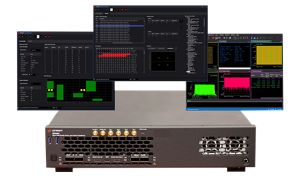

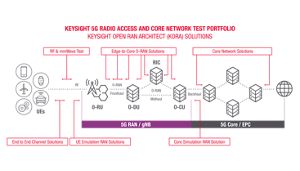
Open RAN (O-RAN) wireless networks are moving toward a virtualized, disaggregated RAN with standard interfaces. Keysight’s end-to-end Open RAN Architect solutions enable conformance, interoperability, performance, and security testing across the entire lifecycle with suites specifically tailored for chipset makers, software stack developers, network equipment manufacturers (NEMs), mobile operators, and Open Test and Integration Centers (OTICs).
Explore our Open RAN Architect solutions and suites for answers to your Open RAN test needs and to simplify sharing of results across the workflow.
Towards Higher Energy Efficiency in Your Network


Energy efficiency is the key to the sustainable and profitable growth of cellular networks. Keysight E-Plane ETSI & Design Test Suites enable you to achieve this objective by providing tools that measure energy consumption (EC) in RAN/vRAN/O-RAN components and characterize energy efficiency (EE) and energy savings (ES).

Find the Model that's Right for You

Additional Resources












-


"Our relationship with Keysight enables a growing small cell ecosystem to leverage open RAN standards. We're happy to support small cell vendors speed up validation of new designs using Keysight's integrated 5G test solutions and small cell reference designs using the Qualcomm 5G RAN platform."
Puneet Sethi, senior director of product management, Qualcomm Technologies, Inc.
-
"In this era of pervasive and connected intelligence, disaggregated network functions using O-RAN-compliant interfaces will help the industry realize the full potential of a virtualized network architecture. Strong technology partners who are committed to driving rapid innovation, such as Keysight with the new Open RAN Studio O-DU emulation software, allows Xilinx to accelerate the deployment of our adaptive computing technology to create highly agile platforms that support the stringent demands of 5G."
Dan Mansur, vice president, marketing, Wired and Wireless Group, Xilinx, Inc.
-
"Keysight's cutting-edge tools, developer support, and leading 5G expertise, enable Mavenir to effectively validate our radio access network solutions. Keysight's solutions improve our ability to flexibly deliver high-quality software to our telco customer base and better support the OpenRAN ecosystem."
Mikael Rylander, general manager of the Radio Access business unit at Mavenir
-
"Keysight has provided Innogence access to an integrated edge-to-core portfolio that is critical to efficiently validating each network component and verifying their performance when part of multi-vendor RAN. We rely on Keysight's solutions to establish interoperability between O-RAN compliant radio units (O-RUs) and distributed units (O-DUs), across the protocol stack, from the physical layer to the application layer."
Chun YIN, deputy general manager at Innogence
-
"We rely on partners such as Keysight to effectively develop and validate open RAN standards-based network elements, including small cells and O-RAN compliant radio and distributed units. Working with Keysight, with cross-domain expertise, enables CIG to derive insights critical in the design and manufacturing of a flexible infrastructure that serves diverse use cases for consumers and vertical industries."
Haibo Zhao, chief technology officer at CIG
-
"We rely on end-to-end 5G test solutions, from the edge of the RAN to the core of the network, to validate a connected portfolio of products developed for disaggregated network architectures. Keysight's UEE test solutions allow us to efficiently address specifications set by both 3GPP and O-RAN standards organizations, helping to ensure that our solutions comply with evolving market demands."
Zhong Cheng, technical director at Comba Telecom
-
"Keysight's solutions enable Baicells to offer high-performing OpenRAN solutions that will meet the coverage and data rates mobile operators need to deliver a wide range of 5G and multi-RAN services. As a provider of OpenRAN systems, ranging from access base stations and backhaul, to evolved packet core (EPC) and 5GC, we rely on proven test platforms with wide industry adoption."
Kristy Chen, vice president of product marketing at Baicells
-
"SOLiD understands the significant role ubiquitous wireless coverage plays in keeping people connected and safe in a rapidly changing world. This is why we choose to partner with Keysight, a company with 5G test solutions that enable us to accelerate performance validation of SOLiD's O-RAN radio units."
Dr. Dae-Young Kim, executive vice president of the Global Wireless business unit at SOLiD
Protect Your Innovation Investment


Want help or have questions?


